
Red Light & NIR Therapy Benefits: The Essential Guide Before You Buy
The essential guide to Red Light & NIR Therapy—understanding the benefits, the technology, and how to choose wisely.
Welcome to the Guide Before You Buy
Once you’ve got your fill of the basics, continue to our companion guide for our top device recommendations: The Essential Buyer’s Guide: The Best Red Light Therapy & NIR Devices of 2026
If you’ve spent any time exploring modern wellness trends lately, you’ve probably seen people sitting in front of glowing red panels, wearing futuristic face masks, or relaxing in what looks like a spaceship tanning bed.
It looks impressive—but what exactly is going on? Is it just a fancy tanning bed?
(Spoiler: Nope! It doesn’t use any harmful UV rays at all).
Today, we’re breaking down Red Light Therapy and Near-Infrared (NIR) Therapy in plain, simple English. No heavy medical jargon—just the honest facts on what it does, how it works, and how to choose the best option for you.
What Is Red Light & Near Infrared (NIR) Therapy?
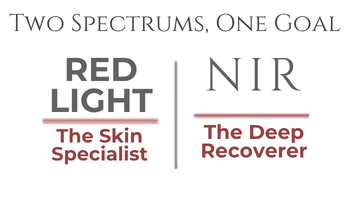
Red Light Therapy and Near Infrared (NIR) Therapy are forms of photobiomodulation—which is just a fancy, scientific term for using specific wavelengths of light to support cellular function.
Wavelengths determine exactly where the light is absorbed and what tissues it targets. While both Red Light and NIR belong to the same family of light therapies, they work at completely different depths within your body:
- Red Light (630–660nm): Primarily interacts with the skin’s surface and upper tissue layers. This makes it your go-to for skin health, collagen support, and complexion-related concerns.
- Near Infrared (810–1064nm): Penetrates much deeper, reaching past the skin into muscles, joints, connective tissue, and deeper structures. This makes it incredibly popular for workout recovery, circulation, performance, and whole-body wellness.
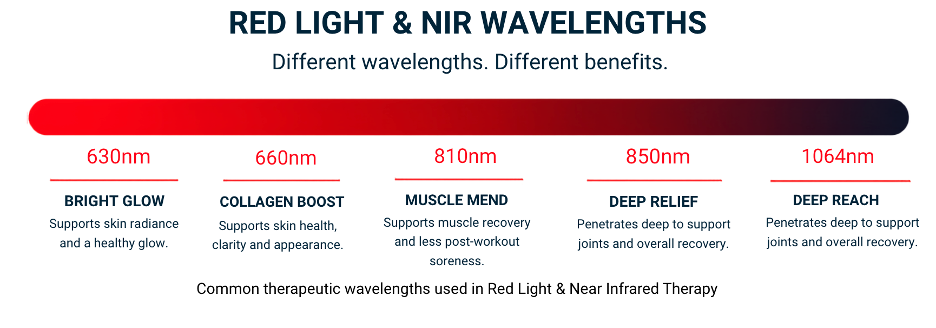
Think of it this way:
- Red Light = The Skin Specialist
- Near Infrared (NIR) = The Deep Recovery Specialist
Together, they create one of the most versatile wellness combinations available today!
How Does It Work?
(Think of It Like Human Photosynthesis!)
You know how plants soak up sunlight to create energy and grow? Humans do something incredibly similar.
Our cells contain tiny, internal energy factories called mitochondria. When our body is exposed to specific wavelengths of red and near-infrared light, those mitochondria absorb the light and use it to instantly produce more cellular energy, known as ATP.
When your cells have more energy, they can do their everyday jobs much faster. That means faster healing, quicker recovery after a tough workout, and more efficient skin rejuvenation!
Red Light or Near-Infrared: What’s the Difference?
Even though they are frequently bundled together in the exact same wellness devices, they actually have two completely different specialties based entirely on how deep they can reach into your body:
| Type of Light | Where It Goes | What It’s Best For |
| RED LIGHT(630–660nm) | Stays within the surface and upper layers of the skin. | Collagen support, skin tone, fine lines, wrinkles, redness, and acne-prone skin. |
| NEAR INFRARED (NIR)(810–850nm & 1064nm) | Penetrates deeper into muscles, joints, connective tissue, and bone. | Recovery, circulation, joint comfort, muscle soreness, performance, and deep tissue support. |
Your Guide to the Products
Red light and NIR therapies come in a massive variety of shapes and sizes. Depending on your lifestyle, you can find everything from home-use face masks and handheld devices to massive, industrial-sized full-body panels.
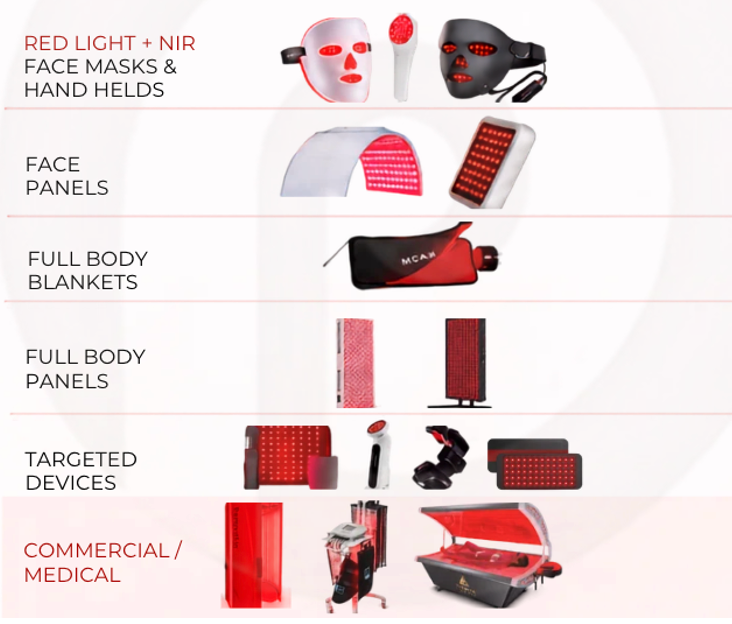
If you are looking to purchase a home device, don’t get distracted by flashy marketing graphics. Keep your eyes on three specific values:
- Wavelength (NM): This determines where the light goes and what it targets. Always look for devices that clearly disclose their exact nanometer metrics.
- Ideal Red Light Range: 630–660 NM
- Ideal NIR Range: 810–850 NM (and up to 1064 NM)
- Irradiance (Power Output): If wavelength determines where the light goes, irradiance determines how much usable light energy actually reaches your body. Think of irradiance as the pure horsepower of the device. It dictates how hard those LED bulbs are working to deliver results.
- Proof (Quality & Transparency): The transparency a company provides about its device is a major green flag. If a company cannot clearly explain or back up how its device performs, that is your cue to keep shopping! Before you pull out your credit card, look for:
- Third-party testing confirmation
- Explicitly stated wavelength, irradiance, and electrical power metrics
- FDA clearance or approval
Going Professional: Clinical & Commercial Systems
While most people kick off their journey with home devices, professional-grade systems are popping up everywhere. Today, you can easily book full sessions at wellness spas, athletic recovery lounges, chiropractic clinics, cryotherapy centers, and even local fitness facilities.
These commercial systems are typically much larger, significantly more powerful, and engineered to deliver a complete full-body treatment in a single session. They also frequently utilize deeper Near-Infrared wavelengths (like 1064nm) for advanced body recovery.
If you are on the fence, professional treatments are a fantastic “try before you buy” approach to experience the whole-body benefits firsthand before investing in your own home setup.
Protocols for Success & Safety
When it comes to light therapy, consistency always beats intensity! However, more is not always better.
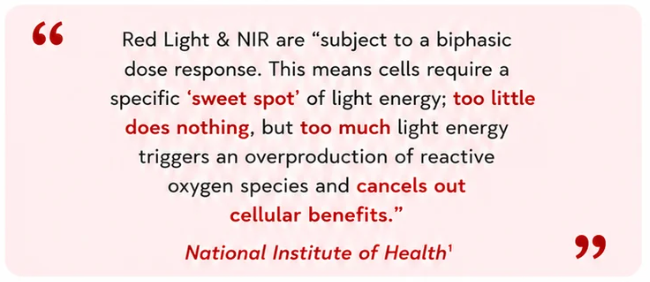
Research shows that our cells respond best within a very specific therapeutic “sweet spot”. Think of it as a biphasic dose response: too little light energy won’t provide much of a benefit, but hitting your cells with too much light energy can actually cause an overproduction of reactive oxygen species, which completely cancels out the cellular benefits you are trying to achieve.
To get the best results safely, stick to these basic guidelines:
- Red Light (630–660 NM): Aim for 3 to 5 times per week, for about 10–20 minutes per session.
- Near-Infrared (810–850 NM): Aim for 3 to 5 times per week, for 10–20 minutes per session.
- Deep NIR (1064 NM): Aim for 3 to 4 days per week, for 12–20 minutes per session, ensuring you leave a 48-hour rest period between deep sessions.
A Few Cautions Before You Glow
For 99% of healthy individuals, light therapy is incredibly safe, completely painless, non-invasive, and highly relaxing. Still, apply a little bit of common-sense care to your routine:
- Protect Your Eyes: Even though red light is therapeutic, staring directly into a high-powered LED panel is a terrible idea. Always wear the opaque safety goggles provided by the manufacturer or your clinic establishment.
- Talk to Your Doctor First If: You are pregnant, have an active skin condition, a history of skin cancer, or take any photosensitizing medications (like certain intense acne treatments) that make your body extra sensitive to light.
- Don’t Overdo It: Your cells can only absorb so much light energy at once! Sticking to a 10–20 minute window is perfect. Sitting in front of a panel for an hour won’t give you double the results—your cells will literally “fill up,” tap out, and stop responding.
Final Thoughts
At the end of the day, Red Light and Near-Infrared therapies aren’t magic. They are simply beautifully designed, natural tools that support your body’s built-in ability to recover, repair, and function at its absolute best.
Whether your ultimate goal is a more radiant skin complexion, faster workout recovery, better circulation, or deep joint relief, the secret is simple: choose a quality device, fit it into your schedule, and stay consistent.
Start simple, focus on quality spec transparency over marketing hype, and let your cells do exactly what they were designed to do. Your future self will definitely thank you for it! Enjoy the glow!
Sources
National Institutes of Health (NIH). Photobiomodulation Therapy Research and Clinical Applications. Retrieved from https://www.nih.gov
National Center for Biotechnology Information (NCBI). Photobiomodulation and Red Light Therapy Studies. Retrieved from https://www.ncbi.nlm.nih.gov
Cleveland Clinic. Red Light Therapy: Benefits, Uses, and Considerations. Retrieved from https://health.clevelandclinic.org
Harvard Health Publishing. Light-Based Therapies and Emerging Wellness Applications. Retrieved from https://www.health.harvard.edu
American Academy of Dermatology (AAD). Acne, Skin Rejuvenation, and Light-Based Treatments. Retrieved from https://www.aad.org
Incredibly helpful. I have wondered about whether red light was actually useful or just a trend.
It’s about damn time! We have to normalize good information like this! Waiting on the Pulse Pick on this?!!!!