
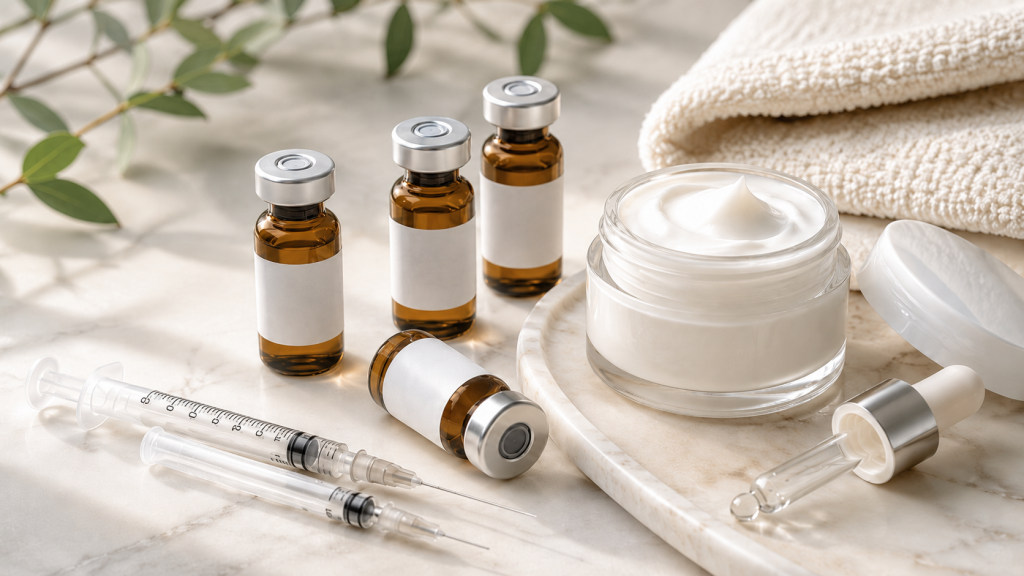
Peptides are having a major wellness moment — from skincare and fitness recovery to weight management and “anti-aging” conversations. But what are peptides, really? And why is everyone suddenly talking about them?
Like many wellness trends, peptides sit in that tricky space between real science, emerging research, medical use, beauty marketing, and internet hype. Some peptides are well-established in medicine. Others are being promoted online with claims that may move faster than the evidence.
So before jumping into the buzz, let’s break it down in plain language.
What are peptides?
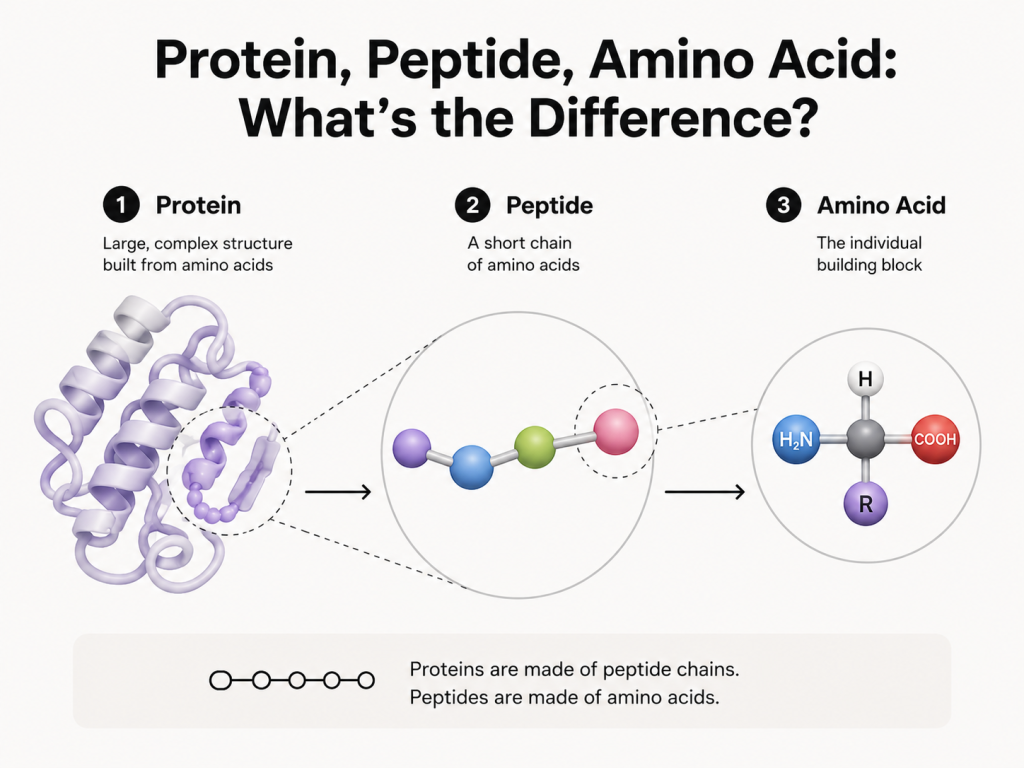
Peptides are short chains of amino acids. Amino acids are often described as the building blocks of proteins.
A simple way to think about it:
- Amino acids are the individual building blocks.
- Peptides are small chains of those blocks.
- Proteins are larger, more complex structures built from amino acids
Your body naturally makes many different peptides, and they can play different roles depending on their structure and purpose. Some peptides act like messengers, helping the body send signals and communicate certain biological instructions, while others may support specific functions such as tissue repair, hormone regulation, immune response, skin structure, metabolism, or recovery.
| The simple takeaway… In many cases, peptides are designed to mimic substances your body already naturally makes and uses. That does not mean every peptide-based product is automatically safe, proven, or right for everyone. But it does help explain why peptides are getting so much attention in skincare, wellness, and medicine. |
Why are Peptides Suddenly Everywhere?
Peptides are not new. Your body naturally makes them, and some peptides have been used in medicine for years. What has emerged, making peptides appear “new,” is how visible they have become across areas such as skincare, weight management, inflammation, fitness and muscle support, hair growth, energy, sleep, and longevity — just to name a few.
This is where the peptide conversation can get confusing. Some uses have real science behind them, some are still being studied, and some are marketed with claims that may be moving faster than the evidence. The word “peptide” can also refer to very different things — from a skincare ingredient, to a prescription medication, to an unapproved product being sold online. Those are not all the same thing.
Peptides in Skincare
Skincare is one of the most common places consumers encounter peptides, usually through labels that say things like multi-peptide, peptide complex, or peptide-enriched.
Topical peptides are often marketed to support the appearance of firmer, smoother, or more hydrated skin. But a label that says “peptides” does not automatically mean the product is meaningfully changing your skin.
This is still a growing area of study. Some cosmetic peptides show promise, but the evidence varies widely depending on the specific peptide, the formula, the concentration, and whether the product can actually deliver the ingredient where it needs to go.
| The simple takeaway… Peptides in skincare are promising, not magical. As of now, there is no major topical peptide ingredient that should be treated as a “guaranteed” skin-transforming solution. The word “peptide” on a label is not proof that a product works. |
Peptides in Medicine & Fitness
This is where the peptide conversation becomes more serious — and more important to understand.
Some peptides are used as real medications. They may be prescribed for specific conditions, studied in clinical trials, and regulated through established medical pathways.
Examples include insulin, GLP-1 and GLP-2 medications, and the latest GLP-3 therapies currently in clinical trials. These are peptide-based therapies used in medical care, including areas many people recognize today, such as weight loss, weight management, and blood sugar control.
But when people talk about peptides in the wellness space, they are often talking about a much wider category.
Important context
The following peptides are especially relevant because they are expected to be reviewed by the FDA’s Pharmacy Compounding Advisory Committee. This does not mean they are FDA-approved medications. It means their regulatory status is being evaluated.
General Health
- KPV — inflammation and immune response.
- Emideltide / DSIP — sleep and stress response.
- Epitalon — longevity and cellular aging.
Fitness & Recovery
- BPC-157 — tissue repair, injury support, and gut health.
- TB-500 — recovery, tissue support, and mobility.
- MOTS-c — metabolism, energy, and mitochondrial function.
Cognitive Health
- Semax — focus, cognitive support, and brain function.
Read More → For a deeper breakdown of the FDA’s recent peptide review, see our related Pulse post, “The FDA Is Weighing Peptides…”
Other Popular Peptides:
- GHK-Cu — inflammation, skin health, collagen support, and hair/nail growth.
- 5-Amino-1MQ — metabolism and fat-storage pathways.
- Tesamorelin — growth hormone pathway and body-fat redistribution.
- Cagrilintide — appetite regulation and weight management support.
- Glutathione — antioxidant support.
- Selank — stress response, anxiety support, and cognitive function.
| Semax and Selank: Semax is not FDA-approved in the United States, but it is part of the current FDA review list. Semax and Selank are commonly described as approved in Russia, with Semax tied more to neurological/cognitive use and Selank more to stress or anxiety-related use. |
And we would be remiss if we did not mention the ever-so-in-demand, non-peptide: NAD+.
NAD+ is often discussed in the same wellness circles as peptides, but it is not technically a peptide. It is a coenzyme involved in cellular energy and metabolism. Because it is so commonly grouped into the broader peptide/wellness conversation, we cover it separately.
Read more→ See our Pulse post, “NAD+ Is Having a Moment…” for a deeper look at what it is and why NAD+ has become so popular.
| The simple takeaway… Peptides are one of the most talked-about areas in modern wellness and medicine, but they are not all in the same category. Some are approved medications. Some are in clinical trials. Some are being evaluated for compounding. Some are sold as research-grade products not approved for human use. Knowing the difference matters. |
This is also where personal medical guidance matters. Even when a peptide sounds promising, every body is different. Medical history, family history, allergies, medications, autoimmune conditions, cancer history, hormone sensitivity, and overall health status can all matter.
Personal research and education is helpful — and in most cases, essential — but personal medical decisions should be made with proper guidance from a qualified medical professional, medical provider, or appropriately trained wellness clinic.
A peptide that proves to be helpful for one person may not be appropriate for another. This is especially important with peptides that are not FDA-approved for human use.
“Peptides” is Too Broad of a Word
One of the biggest reasons peptides can feel confusing is because people often talk about them like they are all the same thing.
They are not. There are peptides your body naturally makes. There are topical peptides used in skincare. There are peptide-based medications used in medical care. There are peptides being studied in clinical trials. There are compounded peptides. And there are research-grade peptides sold online that are not approved for human use. These categories are simply…not the same.
| The simple takeaway… “Are peptides good or bad?” The better question is: What peptide are we talking about, in what form, for what purpose, from what source, and under whose guidance? |
Why the Hype Can Be Misleading
Peptides are getting attention because they sound advanced, targeted, and full of potential. In some cases, that attention is deserved. Peptide-based therapies are a real and growing area of medicine, wellness, and research.
But the hype can also be misleading.
Online, peptides are sometimes promoted with big claims around fat loss, muscle recovery, skin rejuvenation, anti-aging, sleep, energy, inflammation, and performance. Some of those areas may have real research behind them. Others may be early, exaggerated, or based more on personal stories than strong evidence.
This is also where you may hear the term “stacking.”
What does “stacking” mean?
In simple terms, stacking peptides means using more than one peptide at the same time, often with the idea that they may support different goals or work better together. For example, someone might talk about a “recovery stack,” a “sleep stack,” or a “fat loss stack.”
But stacking also increases the need for caution. More peptides does not automatically mean better results. It can also mean more variables, more potential side effects, more interaction concerns, and more need for proper guidance.
| The simple takeaway… Peptide hype can make these compounds sound simple, but they are not one-size-fits-all. Whether someone is considering one peptide or a stack, the smartest approach is education, caution, and qualified medical guidance. |
Considerations Before a Peptide Commitment
Before considering any peptide product, especially anything injectable, focus on the basics that matter most:
1. What research or evidence supports the claim?
Look for real research, not just testimonials, before-and-after posts, or influencer recommendations.
2. What are the risks or side effects?
Every active compound has potential downsides, even if it sounds “natural” or similar to something the body already makes.
3. Does my personal medical history matter?
Yes. Family history, cancer risk, allergies, autoimmune conditions, medications, hormone sensitivity, and overall health status can all matter.
4. Where is it coming from?
Quality, purity, sterility, sourcing, and storage matter — especially with injectable products.
5. Who is recommending it?
There is a big difference between guidance from a qualified medical professional and advice from an influencer, brand, or online seller.
6. What is its regulatory status?
Is it FDA-approved, under review, compounded, prescribed, or research-grade? These are not the same thing.
The Pulse Perspective
At Pura Place, we are interested in wellness trends, but we are not interested in blind hype.
Peptides are worth understanding because they have a wide array of health and longevity benefits to offer, already part of medicine, skincare, fitness, and wellness conversations. yet they also require careful thinking.
Our goal is for us all to be more informed before making decisions to simplify our wellness and routines.
Subscribe to The Pulse: Want more breakdowns on peptides, biohacking, protocols and wellness trends? Subscribe to The Pulse for deeper dives, guides and practical information.